
The Values Draft
Description
The Values Draft is an opportunity to name and claim your values. The draft asks you to choose the values that are most important to you and - through playful competition, social interaction, and personal investigation - examine the ways in which the values you say you believe are truly embodied both in your day to day life and in your work context, as well as the ways in which they are not.
Materials
1 Values Cards Deck [link to purchase deck]
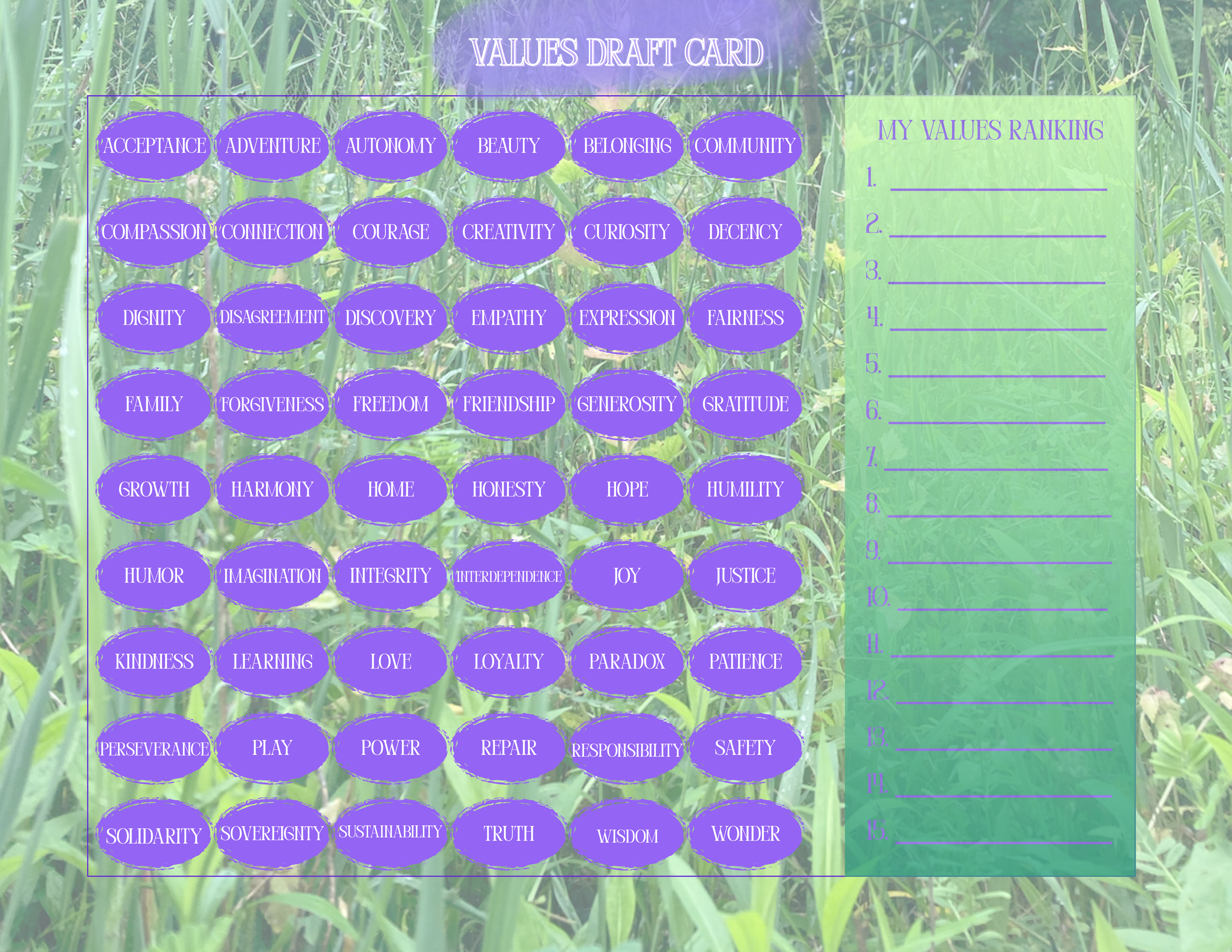
Up to 18 Draft Cards (1per participant) [link to printable PDF]
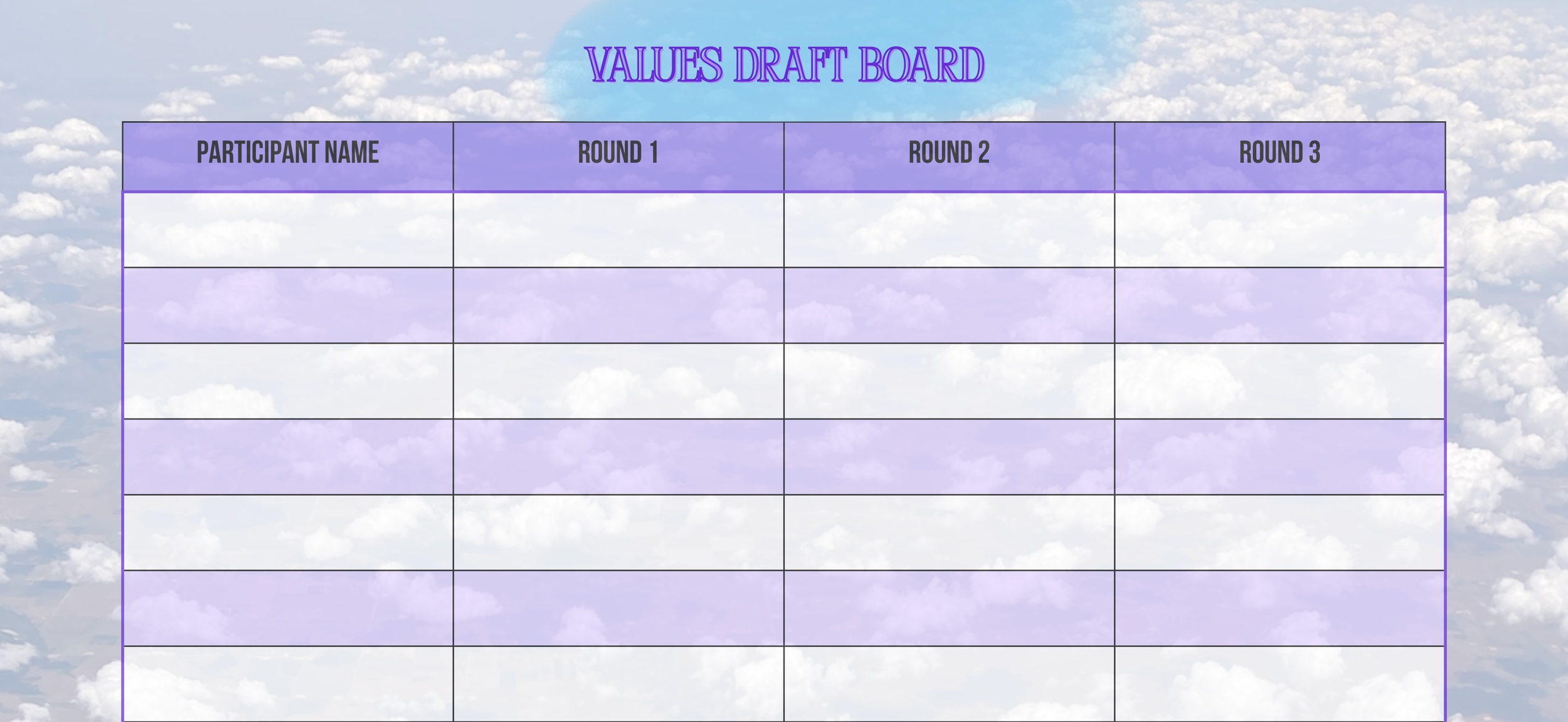
1 Draft Board [link to printable PDF]
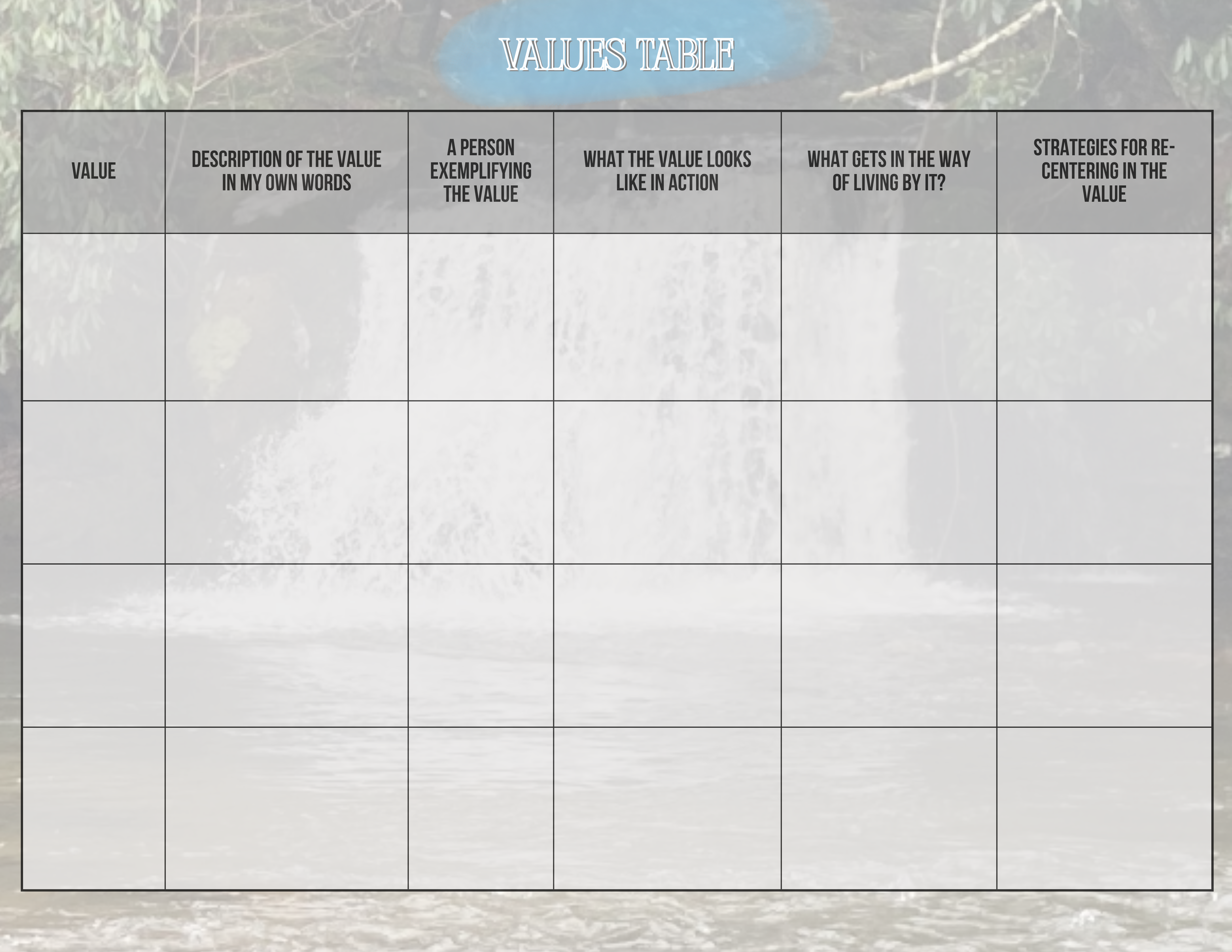
Up to 18 Core Values Tables (1per participant) [link to printable PDF]
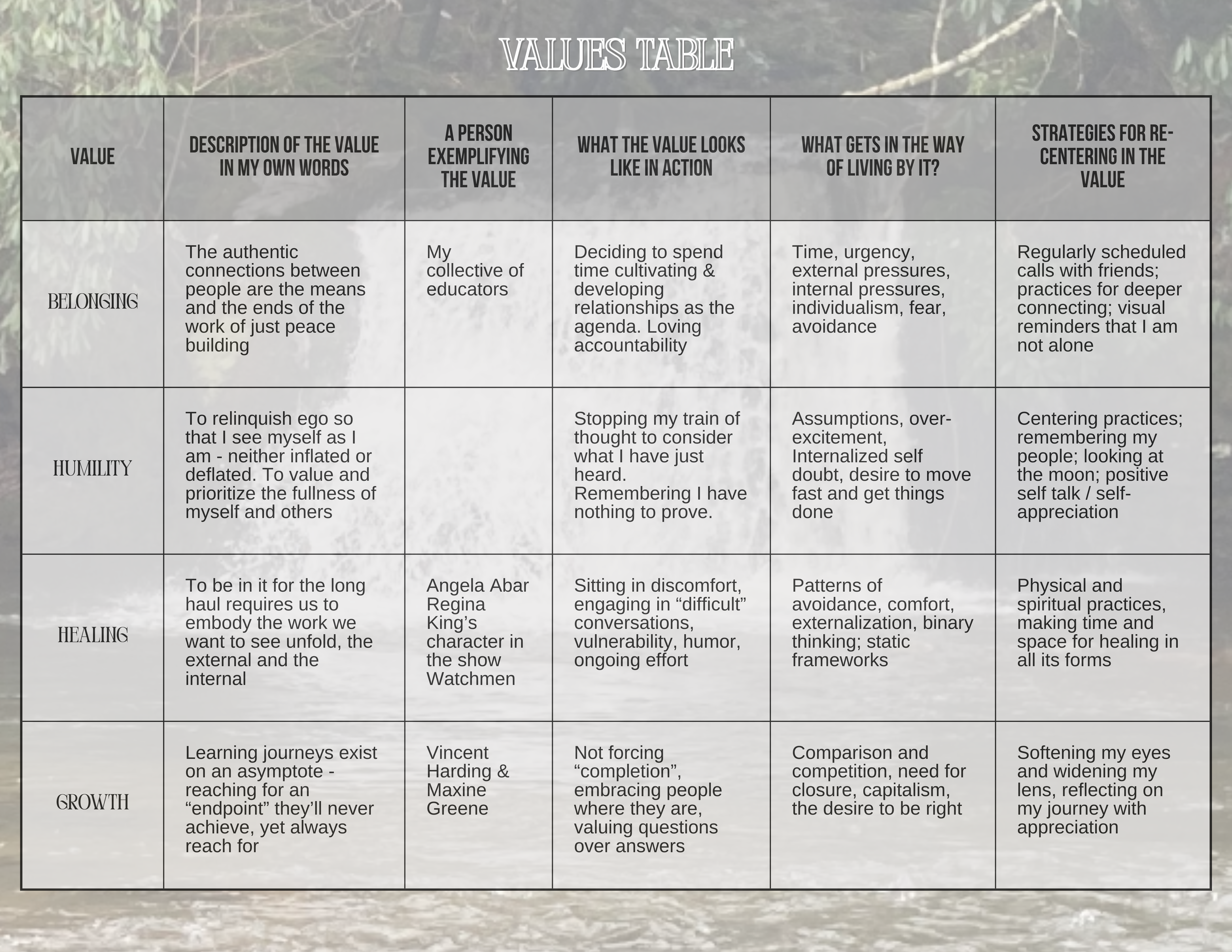
Sample Core Values Table [link to printable PDF]
Instructions
Introduce the Draft:
Today we are going to be drafting our values. What does that mean? It means that in this next activity, you will be competing with each other, through a draft, to select a set of three core values. Your goal is to build a collection of three values that most speak to who you are, to how you aspire to be in the world. But here is the catch: this is a draft so each value may only be selected by one of you. This means that when it is your turn, you will want to choose your values wisely.
Step 1: Create Your Draft Card
Take a moment to review all of the available values and individually rank the values that mean the most to you. You can rank them 1-54 (1 being the value that matters most); you can create a list of your top 10, 15, or 20; or you can sort them into tiers (i.e. Justice, Fairness and Sovereignty all get a 1 because they are all in my first tier - create as many tiers as is helpful to you).
Step 2: Drafting Values
Take a moment to set your group’s draft order (i.e. alphabetical, closest birthday, randomized, etc). The draft will be conducted using “snake draft” rules (Round One: 1, 2, 3… 7, 8. Round Two: 8, 7, 6… 2, 1. Round Three: 1, 2, 3… 7, 8.)
In round one, following the draft order, each participant “claims” a value. When a value is claimed, the facilitator records it on the draft board and reminds the rest of the participants to cross it off their draft card. That value is no longer available to be “drafted”.
In round two, follow the draft order in reverse (the last participant to draft in the first round becomes the first to draft in the second round, and so on). When a value is claimed, the facilitator records it on the draft board and reminds participants to cross it off their draft card. That value is no longer available to be drafted.
In round three, return to the original draft order. When a value is claimed, the facilitator records it on the draft board and reminds participants to cross it off their draft card. That value is no longer available to be drafted.
Once all three rounds have been completed, the facilitator reads out the full draft board (eg. David drafted compassion, integrity, and love; Lori drafted friendship, beauty, and sovereignty; etc.). Then ask participants:
How did it feel participating in the draft?
What came up for you while listening to others draft?
Did anyone get all of the values they wanted?
What did you do when you had to pivot?
Did anyone find themselves choosing a value in the moment that they had ranked lower than another value that was still available?
What else did you notice during the draft?
Step 3: Core Values
Now that we have named our values, we are ready to dive deeper into the practice of living by them. The Core Values activity asks us to take the values that we have “claimed” through the draft and articulate our personal relationship with them. Through building our Core Values we will define the values for ourselves, identify what it looks like when we are living by them, challenge ourselves to name the places we struggle to live by them, and develop strategies to bring ourselves into deeper alignment.
Take the three values you drafted and fill out the columns in the Core Values Table for each of them. You may choose a fourth that you either were not able to draft or was not on the list to begin with but you would like to include as one of your Core Values.
Give participants time to begin filling out the Core Values Table but understand that some of them will want to spend a lot more time on this than you will have available.
Step 4: Reflection and Sharing
After enough time has passed for all of the participants to have gotten through all of the columns for at least one (and hopefully two) of their values, the facilitator calls the group back together to discuss the entire process. Ask participants:
Who wants to share a little about your experience in this process? What came up for you? What did you notice? What did you learn about yourself?
When filling out the Values Table, what did you notice about the people who came to your mind for each of the values?
Does anyone want to share some of the things that get in the way of living by your values? Can others relate to those things?
Throughout this process, what stood out to you in terms of your own relationship with the values?
How might you continue using this Values Table as you practice living your values?